Turn concentrated equity into a lasting philanthropic legacy
A practitioner-level framework — built specifically for founders and executives — that shows you exactly how to evaluate, time, and execute a Donor-Advised Fund contribution around your liquidity event, before the window closes.

"The founders and executives I designed this for don't need inspiration — they need a precise, actionable framework they can walk into an advisor meeting and use."
— Lauren D.
What you'll learn
What you'll be able to do
- Evaluate whether contributing private, pre-IPO, restricted, or newly public shares to a DAF fits your specific philanthropic and wealth-planning objectives
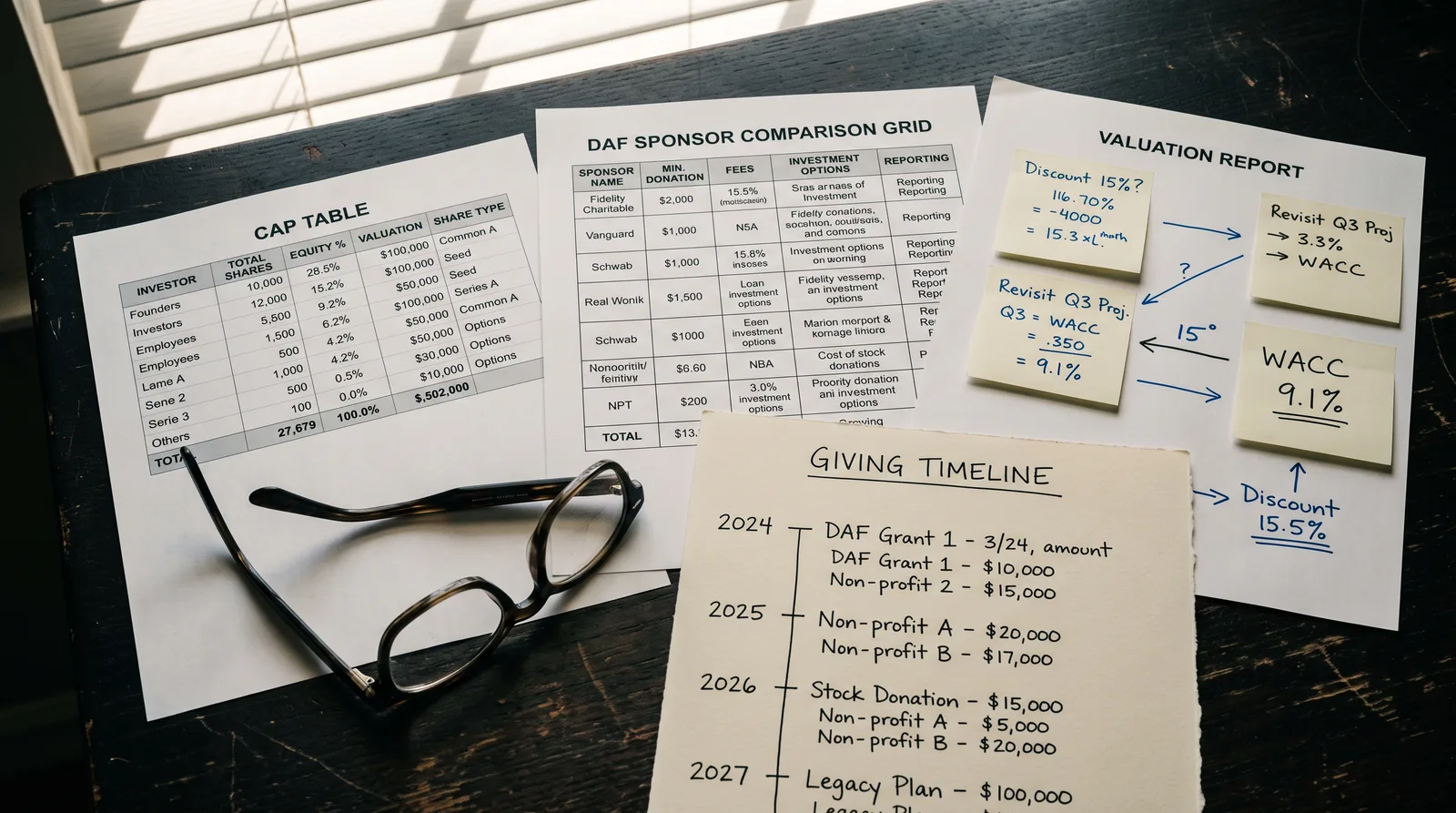
- Map the critical timing windows around a liquidity event — tender offer, IPO lock-up expiration, secondary sale — and identify when a DAF contribution may be most advantageous
- Apply a structured DAF sponsor comparison framework to assess acceptance policies, valuation requirements, fee structures, and investment options for illiquid equity
- Construct a due-diligence and valuation checklist — and identify the qualified appraisers, tax counsel, and legal advisors needed — before contributing complex assets
- Build a decision framework for converting a concentrated equity position into a coordinated, multi-year charitable giving strategy aligned with your personal philanthropic mission
- Produce a personalized DAF Giving & Liquidity-Event Plan, including a professional advisor question guide, that you can bring directly into conversations with your tax, legal, and financial team
How it works
A school that adapts to you
This isn't a set of static videos. Every lesson is generated live and tuned to where you actually are.
We learn your level
A quick placement check tailors your starting point so you're never bored or lost.
Lessons adapt as you go
Each lesson is written for your pace and your goal, adjusting as your skills grow.
Your AI coach keeps you moving
Checkpoints, feedback, and gentle nudges turn progress into a real result.
The curriculum
What's inside your school
6 modules · 28 lessons

The Equity-to-Legacy Opportunity
Establishes why concentrated, illiquid equity creates a unique—and time-sensitive—intersection of wealth planning and charitable giving.
- 1.1Who This School Is For and How to Use ItIncluded
- 1.2The Concentrated Equity Problem — and the Philanthropic LeverIncluded
- 1.3What a Donor-Advised Fund Actually Is (and Isn't)Included
- 1.4How DAFs Handle Non-Cash, Complex AssetsIncluded
- 1.5The Strategic Case: Potential Tax and Philanthropic Benefits of Contributing Equity to a DAFIncluded
Types of Equity and Their DAF Implications
Breaks down the distinct characteristics, constraints, and sponsor-acceptance considerations of each major equity category founders and executives commonly hold.
- 2.1Private Company Stock — C-Corp, S-Corp, and LLC InterestsIncluded
- 2.2Pre-IPO Shares and Early Secondary MarketsIncluded
- 2.3Restricted Stock Units and Stock OptionsIncluded
- 2.4Newly Public Shares and IPO Lock-Up PeriodsIncluded
- 2.5Tender Offer and Secondary Transaction SharesIncluded
Timing Is Everything — Liquidity-Event Windows
Maps the critical decision points before, during, and after a liquidity event where a DAF contribution may be most — or least — advantageous.
- 3.1The Liquidity-Event Timeline: A Founder's MapIncluded
- 3.2The 'Before vs. After' Contribution DecisionIncluded
- 3.3Blackout Periods, Trading Windows, and Insider-Trading RulesIncluded
- 3.4Scenario Workshop: Mapping Your Own Liquidity TimelineIncluded
Valuation, Due Diligence, and Compliance
Builds a rigorous checklist for the valuation, documentation, legal review, and IRS compliance steps required before contributing complex equity to a DAF.
- 4.1Why Valuation Is the Critical VariableIncluded
- 4.2Qualified Appraisers and the Qualified Appraisal RequirementIncluded
- 4.3Legal Considerations: Transfer Restrictions, ROFR, and Shareholder ApprovalsIncluded
- 4.4Sponsor Due-Diligence Requirements and the Acceptance ProcessIncluded
- 4.5Your Due-Diligence Checklist and Professional Advisor TeamIncluded
Choosing the Right DAF Sponsor
Equips learners with a practical comparison framework to evaluate DAF sponsors on the dimensions that matter most for complex, illiquid equity contributions.
- 5.1The DAF Sponsor Landscape: Community Foundations, Nationals, and SpecialistsIncluded
- 5.2The Five Dimensions of Sponsor ComparisonIncluded
- 5.3Questions to Ask Every Prospective DAF SponsorIncluded
- 5.4Real-World Sponsor Comparison WorkshopIncluded
Building Your DAF Giving & Liquidity-Event Plan
Synthesizes all prior modules into a personalized, advisor-ready plan that converts concentrated equity into a coordinated, multi-year philanthropic strategy.
- 6.1Defining Your Philanthropic Mission and Grant-Making VisionIncluded
- 6.2The Concentrated-Equity-to-Charitable-Opportunity Decision FrameworkIncluded
- 6.3Coordinating the DAF with Your Broader Wealth PlanIncluded
- 6.4Your Professional Advisor Question GuideIncluded
- 6.5Capstone: Your Personalized DAF Giving & Liquidity-Event PlanIncluded
Who it's for
Is this you?

The pre-IPO founder
Holds significant founder shares ahead of a public offering and wants to understand the 'before vs. after' contribution decision before the lock-up clock starts.
The equity-rich executive
A C-suite leader with accumulated RSUs and stock options who needs a disciplined framework for integrating charitable giving into an upcoming liquidity event.

The recently liquid entrepreneur
Just closed a tender offer or secondary sale and is now sitting on appreciated assets, looking for a structured strategy before the next transaction.

The mission-driven investor
Holds private company interests and is ready to define a philanthropic mission — but needs to understand exactly how a DAF sponsor evaluates and accepts complex, illiquid equity.
The legacy-minded board member
A seasoned operator with restricted or newly public shares who wants to coordinate a multi-year charitable giving strategy with their broader estate and wealth plan.

The advisor-ready planner
Knows they need tax, legal, and financial counsel but wants to arrive at those conversations with a mapped liquidity timeline, a sponsor comparison, and the right questions already prepared.
Questions
Frequently asked
Your teacher
A note from your teacher
Lauren D.
If you're reading this, you've almost certainly spent years — maybe decades — building something. You hold equity that represents a significant portion of your net worth, and a liquidity event is either approaching or already underway. You may have a vague sense that there's something strategic you should be doing with that equity from a philanthropic standpoint, but the details feel opaque: What exactly is a Donor-Advised Fund, and does it actually work with private or restricted shares? When in the liquidity-event timeline does a contribution make sense — or not? Who are the right advisors, and what should you even be asking them?
I built Equity to Legacy because those questions deserve precise, practitioner-grade answers — not brochure-level generalizations, and not a sales pitch from someone who benefits from the product they're recommending. The curriculum I've designed works through the full decision architecture: the mechanics of how DAFs handle non-cash and illiquid assets, the equity-type-specific implications across private shares, pre-IPO positions, RSUs, options, and newly public stock, and the timing dynamics that make a liquidity event simultaneously the highest-stakes and most time-pressured philanthropic planning window you'll ever face.
Here's the objection I hear most often: "I already have advisors for this." I want to be direct about something: this school is not a replacement for qualified tax counsel, legal advisors, or your financial team. It never pretends to be, and I'll remind you of that throughout. What it is designed to do is make you a far more effective principal in those conversations. There is a meaningful difference between a client who asks "should I do a DAF?" and one who arrives with a clear philanthropic mission, a mapped liquidity timeline, a sponsor comparison already underway, and a list of precise, high-value questions. This school builds the second client.
The capstone of the curriculum — your personalized DAF Giving & Liquidity-Event Plan — is designed to be a living document you carry into your next advisor meeting. It won't make decisions for you. Your specific facts, your tax situation, your company's shareholder agreements, your state's laws: those require professionals who know your file. What the plan will do is ensure that when you sit across the table from those professionals, you're steering the conversation with clarity and intention rather than deferring entirely to a framework someone else built for a different client.
If you hold concentrated equity and you care about where that wealth ultimately flows — to your estate, to causes you believe in, or to some deliberate combination — this is the strategic foundation that planning deserves. I'm glad you're here, and I'm confident the work you do in this school will pay dividends long before the capstone is complete.
— Lauren D.
Start your journey today
Get instant access — learn at your own pace with an AI coach in your corner.
$197/mo
Recurring billing · cancel anytime
Secure checkout · Instant access
- 6 modules, 28 lessons
- AI-adaptive lessons tuned to your level
- Quizzes & checkpoints to lock in progress
- Your own AI learning coach
- Learn on any device, at your pace
- Full access for as long as you're subscribed